
Versioned agents
Types: chat, document, task, and autonomous. Every edit creates a snapshot. Clone, activate, deactivate — no hardcoded features.
Apps · Control Plane · v2.45
Agent Platform
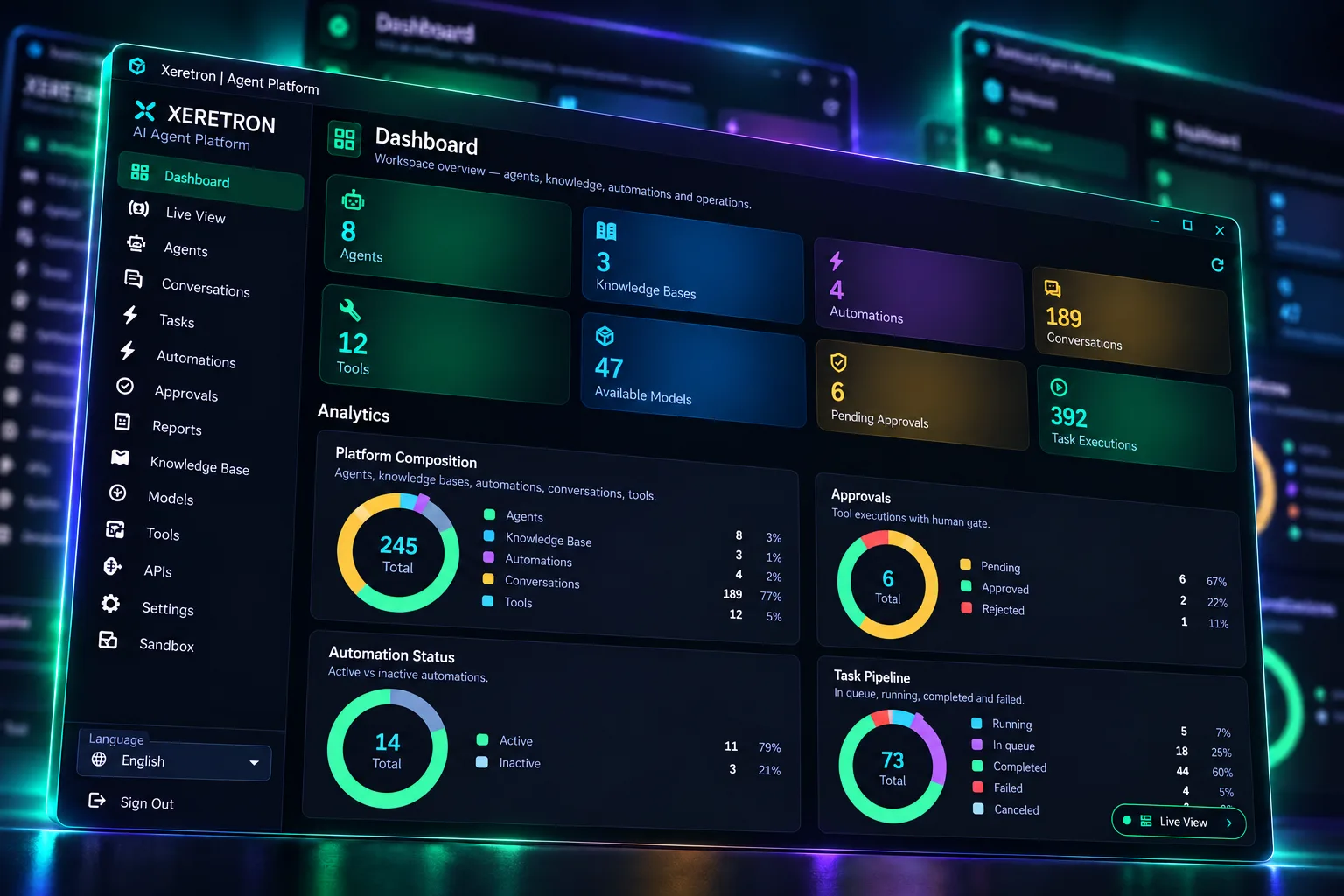
A centralized AI agent platform with permissions, knowledge (RAG), memory, teams, tools, vision browser, human approvals, visual automations, and live observability — governed by an Orchestrator, not the UI.
For operations with governed internal agents, API integrators, and multi-workspace orgs that need isolation and audit. Requires the Xeretron ecosystem (AI Server · Sync · Orchestrator).
Capabilities
Types: chat, document, task, and autonomous. Every edit creates a snapshot. Clone, activate, deactivate — no hardcoded features.
Local bases: upload or URL, indexing, and links to agents. Retrieval before the LLM — if it fails, the turn continues.
Human gate per tool. Pending queue, history, and floating panel. Least privilege: the model only sees granted tools.
Delegates in the same workspace. One hop. The lead coordinates; the delegate can require approval.
Manual, schedule, webhook, or event triggers. Visual node editor (n8n-style). Runs and logs.
Agent presence, active chats, browser, delegations, and events. Real-time observability.
Control Center · 14 modules
Workspace KPIs, composition, pipeline, and recent activity. Live: presence, active chats, browser, delegations, and floating hub.
CRUD, clone, multi-tab editor. Streaming chat with VL and attachments. Task queue with prepare → execute → finalize timeline.
Visual node editor, triggers, and webhooks. Human gate with pending queue and history.
RAG bases, model catalog ≤35B (VL unlocks images), read-only builtins, and restricted Python scripts.
xrtk_… keys, Orchestrator/Sync URLs, and in-app manual. CSV / Excel / TXT export. Language, timezone, and AI Server link.
Agents
Not fixed features. Versioned entities: identity, instructions, models, tools, knowledge, team, memory, plugins, and permissions.
Turn pipeline
Flutter never orchestrates or enforces permissions. The Orchestrator does.
Plugin · Internet Browser
On Windows with WebView2: navigate, tabs, click, type, scroll, screenshot, extract_text, submit, and cookies. VL flow: viewport capture → pixel click → extract / forms.
Browser panel in the conversation; background sessions.
Best with multimodal models: the agent sees and acts on the page.
Structured organic results for research and workflows.
How it works
Desktop app: create, operate, observe. Never runs tools or enforces permissions on its own.
Source of truth: agents, grants, RAG, memory, approvals, tasks, automations, and live.
Streaming inference (models ≤35B), login with link_code, OCR/extract for chat and knowledge.
Isolated workspaces and role memberships. Talk about organizational isolation — not cloud “projects” as a product UI feature.
Security and governance
xrtk_… API keys and credentials encrypted at rest. Generate, reveal, revoke.
Per-agent data. Scripts without free imports; I/O only under the agent root.
Auth, agent CRUD, tools, approvals, models, and nodes — operational traceability.
Integrations
Same Bearer on REST and WebSocket. In-app integration manual. Automation webhooks. Exportable reports by agent and date range.
Platform
Desktop Control Center client. Browser plugin with WebView2. UI in English and Spanish. macOS coming soon.
FAQ
No. It’s the Control Plane: create, manage, run, and orchestrate agents with permissions, RAG, memory, tools, and automations.
Yes. AI Server for inference, Sync for login/link_code, Orchestrator as backend, and File Server for OCR/extract when needed.
The real model is Organization → Workspace → memberships/roles. Isolated workspaces — not a “projects” product UI feature.
For now Windows only. macOS is coming later.
The Orchestrator. The UI shows hints; the backend enforce-all.
Next step
Govern agents with permissions, knowledge, teams, and automations — version 2.45.